MVP Development Contracts — 5 Clauses Every Founder Must Check
The 5 contract clauses that cause 90% of outsourcing disputes. Scope, payment, ownership, acceptance, and termination — check these before you sign.
Bottom Line
90% of MVP outsourcing disputes start in the contract. Before a single line of code is written, check these 5 things: scope, payment terms, source code ownership, acceptance criteria, and termination conditions.
Why the Contract Matters More Than the Code
Many projects start with "just build it" and end with "that's not what I asked for." Usually it's not a skills issue. The contract didn't define scope and standards clearly enough.
First-time founders often skip the fine print, assuming good faith will carry the project. It won't. Good relationships are sustained by clear agreements, not the other way around.
1. Scope: "All Necessary Development" Is a Red Flag
The most important clause in the contract. If scope is vague, everything else falls apart.
What to check:
- Is the scope defined in a separate attachment (scope document, feature spec)?
- Are inclusions and exclusions explicitly listed?
- Is there a change request process with separate pricing?
- Are verbal requests excluded from the contract scope?
Watch out for this:
"The developer shall perform all development and other tasks as needed by the client."
This single line lets the client request anything — design, planning, server ops, marketing pages — under "other tasks."
It should read:
"The developer's scope is limited to features and deliverables specified in the attached [Scope Document]. Items not listed require a separate change order with mutual written agreement."
2. Payment: "Paid After Final Acceptance" Is a Trap
Working 3–6 months and getting paid only after final sign-off is dangerous for both sides. Milestone-based payments let clients verify progress at each stage and ensure developers aren't working for months without compensation.
What to check:
- Is the total amount stated as VAT-exclusive?
- Are payments split into milestones (deposit → interim → final)?
- Are payment deadlines specific (e.g., within 7 business days)?
- What happens if payment is delayed?
Watch out for this:
"Payment shall be made in full after the client's final acceptance." "Payment will be processed after internal approval."
The first means zero income until the entire project is done. The second has no concrete timeline.
It should read:
"Deposit 30%: within 7 business days of contract signing. Interim 40%: within 7 business days of Phase 1 acceptance. Final 30%: within 7 business days of final acceptance."
Be cautious with vendors who start work without any deposit. A deposit signals commitment from both sides.
3. Source Code Ownership: Don't Blindly Hand Over "Everything"
Who owns the code after the project matters enormously. If the vendor retains ownership, switching to another team or maintaining it internally may require rebuilding from scratch.
On the flip side, if the contract forces the vendor to hand over all code including pre-existing libraries and frameworks, the vendor can't reuse them in future projects. That's bad for both parties — it drives up costs for everyone.
What to check:
- Does ownership transfer to the client upon full payment?
- Is ownership retained by the vendor until payment is complete?
- Are the vendor's pre-existing libraries/frameworks excluded from the transfer?
- Are server, domain, and app store accounts under the client's name?
Watch out for this:
"All source code, libraries, tools, and frameworks developed by the developer in connection with this project shall belong to the client."
It should read:
"Source code newly written for this project transfers to the client upon full payment. The developer's pre-existing libraries and frameworks are excluded from the transfer. The client receives a non-exclusive license to use them for operating the project deliverables."
4. Acceptance and Warranty: "Until Satisfied" Never Ends
Without clear acceptance criteria, the project never finishes. "It feels a bit off" becomes infinite revision requests, leaving the developer exhausted and the client unsatisfied.
What to check:
- Is the acceptance period defined (e.g., 14 business days after delivery)?
- Are criteria based on the scope document, not subjective satisfaction?
- Is there a deemed-accepted clause if no objections are raised?
- Is the number of revision rounds capped (e.g., max 2)?
- Are warranty (bug fixes) and maintenance (new features) clearly separated?
Watch out for this:
"The client may request revisions until satisfied with the deliverables." "The developer shall provide free maintenance for 12 months after delivery."
The first means acceptance never completes. The second means a year of unpaid work.
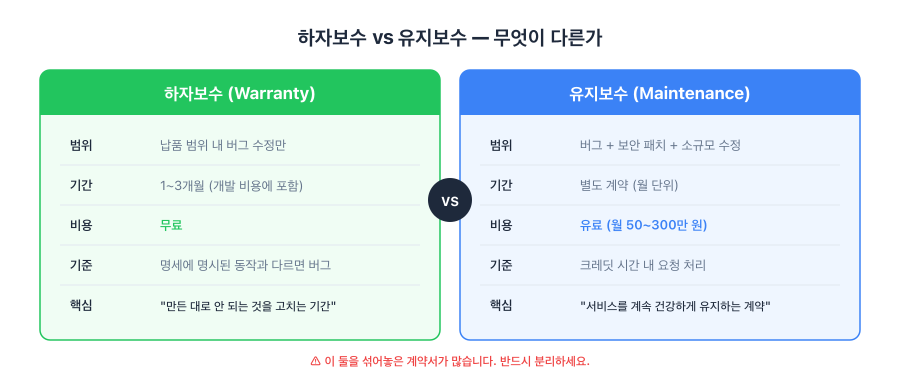
Warranty vs Maintenance:
| Warranty | Maintenance | |
|---|---|---|
| Definition | Fixing bugs within the delivered scope | New features, operations, server management |
| Duration | 1–3 months (varies by project size) | Separate contract |
| Cost | Included in project price | Paid (monthly contract) |
Many contracts blur these two. Always separate them.
5. Termination and Liability: Make Sure It's Not One-Sided
Projects can stop midway. The client's situation changes, funding dries up, or direction shifts. How completed work gets compensated in that scenario is critical.
What to check:
- Are termination rights symmetrical (not just the client)?
- Is there pro-rata payment for completed work upon termination?
- Can the developer terminate if the client fails to pay?
- Is total liability capped (typically at the contract value)?
- Are indirect damages and lost profits excluded?
Watch out for this:
"The client may terminate this agreement at any time by written notice, and the developer shall refund all payments received." "The developer shall be liable for all damages incurred by the client in connection with this agreement."
The first: three months of work, full refund. The second: unlimited liability including lost revenue.
It should read:
"Upon termination, payment for completed work shall be settled proportionally based on progress." "The developer's total liability shall not exceed the total contract value. Indirect damages and lost profits are excluded."
Pre-Signing Checklist
Before you sign, verify these 5 items.
- Scope is defined in a separate attachment, with no catch-all phrases
- Payments are split into milestones (deposit / interim / final)
- Source code ownership transfers upon full payment, with vendor's pre-existing assets excluded
- Acceptance has clear criteria, timeline, revision caps, and warranty is separated from maintenance
- Termination includes pro-rata settlement, and liability is capped
If any of these are missing, ask for revisions before signing. A good vendor won't refuse.
Wrapping Up
A contract is insurance you buy while the relationship is good. Even with mutual trust, scope, money, ownership, acceptance, and termination need to be documented clearly. That way, when issues arise, you resolve them based on the contract — not emotions.
If this is your first MVP contract and you're unsure what to include, share your requirements. We'll help structure the scope and contract terms together.
Get notified of new posts
We'll email you when a new blog post is published.