How Much Should MVP Development Actually Cost?
Why MVP quotes vary so much, how to evaluate them, and practical ways to keep costs reasonable.

Bottom Line
There's no single answer to "how much does an MVP cost?" But there is a framework for judging whether a quote is fair. The right question isn't "how much?" — it's "how do I know if this quote is reasonable?"
Why Quotes Vary by 3x for the Same Project
Send the same brief to three vendors, and you'll get quotes ranging from $5,000 to $30,000. It's not a scam — they're using different pricing models.
| Model | Description | Trade-off |
|---|---|---|
| Fixed package | "App MVP for $X" flat rate | Scope disputes if requirements shift |
| Headcount × Duration | "2 devs × 2 months" | You pay for inefficiency |
| Time-based WBS | Task breakdown → hour estimate → rate applied | Transparent, but takes effort |
When you receive a quote, choose the vendor who can explain how they got to that number. A quote with task lists, estimated hours, and hourly rates is the most trustworthy.
3 Variables That Determine MVP Cost
1. Architecture Choice
App, web, or both — this decision sets the cost baseline.
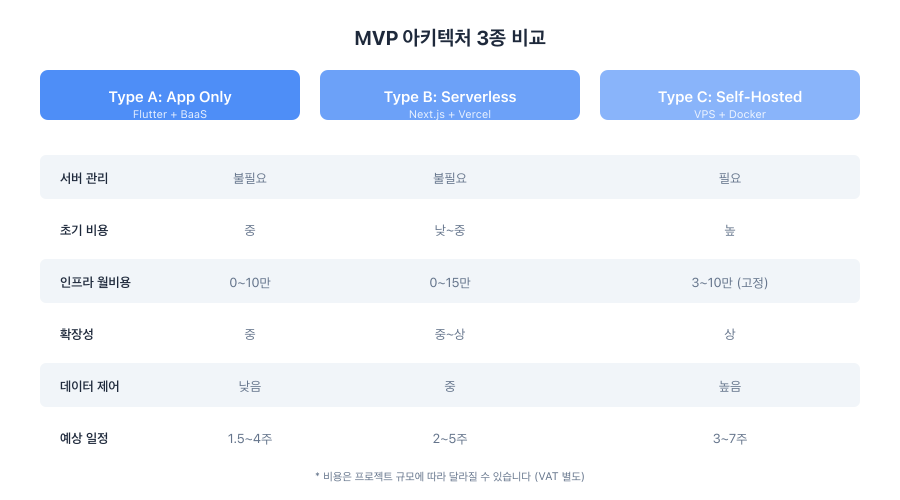
- App-centric (BaaS): Flutter + Firebase/Supabase — no server management, fastest start
- Web-centric (Serverless): Next.js + Vercel + Supabase — web + admin panel in one
- Full-stack (Self-hosted): Next.js + Node.js + PostgreSQL — full control, regulatory compliance
Generally, app-centric starts fastest, while full-stack offers more flexibility at the cost of more development time. Time is money, so choosing the right level of architecture is your first saving.
2. Number and Complexity of Features
This is where most cost differences come from. Same architecture, but 3 features vs 10 features can mean a 2–3x cost difference.
Features that significantly impact cost:
- Admin panel — cost scales sharply with the number of screens; often over-built at the MVP stage
- Real-time features (chat, notifications) — much more complex than basic CRUD
- Payment integration — PG connection + webhooks + refund handling adds up
- AI features — SDK integration is fast, but prompt engineering and UX design take time
- Third-party integrations — time can be unpredictable depending on the other party's API docs
The key is to pick only what you need right now. Everything that's "nice to have" goes to Phase 2.
3. Design
Custom design adds a separate cost line. At the MVP stage, a UI system like Tailwind + ShadCN gives you a clean look while saving significant budget. Pixel-perfect design can wait until after you've validated Product-Market Fit.
Quote Evaluation Checklist
When you receive a quote, check these items:
Transparency
- Is the work broken down into individual items?
- Does each item have an estimated time or cost basis?
- Are there no catch-all phrases like "other development as needed"?
Scope
- Are inclusions and exclusions clearly stated?
- Is it clear whether design, content, and hosting are separate or included?
- Are change request costs defined?
Post-launch
- Is a warranty/bug-fix period specified?
- Are maintenance and operations options outlined?
- Does source code and account ownership belong to the client?
A quote that passes this checklist is trustworthy regardless of the amount.
5 Ways to Reduce MVP Cost
1. Cut Features
The most effective method. Focus on one core feature and push everything else to Phase 2. Dropping one feature typically eliminates dozens of development hours.
2. Define Requirements Clearly
"Just make it good" is the most expensive requirement. Specifying features screen by screen makes estimates more accurate — and accurate estimates tend to be lower.
3. Start with a Minimal Admin Panel
Admin panel costs scale sharply with screen count. Start with the minimum needed to manage core data, and add screens as you operate.
4. Don't Over-Architect
If you don't need a self-hosted server, going full-stack adds unnecessary cost and time. "Start simple, scale when needed" is the MVP principle.
5. Plan for Maintenance
An MVP left unmaintained for a few months often costs as much to fix as to rebuild. A small maintenance contract is far cheaper in the long run.
Red Flags in MVP Quotes
Extremely low quotes
A quote at half the market rate usually covers only basic features. Final costs often end up 2–3x the initial quote once real features are added. Ask about the total cost, not just the starting price.
Quotes based solely on "headcount × duration"
"3 developers × 2 months" tells you nothing about what those 3 people will actually do. Choose a vendor that can show a task-level breakdown (WBS).
No mention of post-launch costs
Vendors who only quote development costs often aim for "deliver and done." Confirm upfront what bug fixes, server management, and feature additions will cost after launch.
Wrapping Up
MVP cost starts with "what are you building?" not "how much?" Define your architecture, narrow down core features, and demand transparent pricing. That's the fastest path to a fair deal.
If you're unsure about project scope or budget, just share your requirements. We'll walk you through architecture recommendations and concrete cost breakdowns.
Get notified of new posts
We'll email you when a new blog post is published.