
MVP Maintenance Costs — How Much Should You Budget?
How much maintenance actually costs after launching an MVP, the difference between maintenance and operations, and how to manage post-launch costs effectively.

Bottom Line
If you budget only for development and ignore post-launch costs, your service will be abandoned within 3 months. Set aside 15–25% of your development cost annually for maintenance. Planning for it from the start is the cheapest option.
3 Types of Cost After MVP Launch
When all the focus goes into building the MVP, post-launch costs are often completely overlooked. In 17 years of shipping projects, I've heard "I never thought about post-launch costs" more times than I can count.
1. Infrastructure (Server/Hosting)
Your service needs a server to run. Depending on the architecture, you can start at $0–100/month during the MVP stage.
| Approach | Starting Cost | At Scale |
|---|---|---|
| BaaS (Firebase, Supabase) | Free tier available | $30–200/month |
| Serverless (Vercel + Supabase) | Free tier available | $50–300/month |
| Self-hosted (VPS) | $30–100/month fixed | Predictable regardless of traffic |
Infrastructure costs are relatively small. The real issue is the next two.
2. Maintenance (Code Management)
Bug fixes, security patches, minor feature adjustments — any work that touches the codebase. It looks fine right after launch, but as users grow and time passes, it becomes unavoidable.
Common situations that require maintenance:
- Users discover a bug
- App store policies change and an update is required
- A dependency has a security vulnerability
- Text or configuration values need to change
Depending on service size and update frequency, expect $500–3,000/month as a market baseline.
3. Operations (Infrastructure Management)
Server monitoring, incident response, backup verification, SSL certificate renewal — keeping the service from going down. This matters most if you're running your own server. With BaaS or serverless setups, the platform handles much of this, so the cost may be minimal or unnecessary.
Maintenance and Operations Are Not the Same Thing
Many founders lump all post-launch work under "maintenance." But maintenance (code) and operations (infrastructure) are fundamentally different. Mixing them up in a contract creates disputes.
| Maintenance | Operations | |
|---|---|---|
| Focus | Code and features | Infrastructure and uptime |
| What it covers | Bug fixes, security patches, feature tweaks | Server monitoring, incident response, deployments |
| When you need it | "This feature is broken" | "The whole service is down" |
If a contract just says "maintenance" without clarification, you'll argue over whether a server outage falls within scope. Either separate the contracts or, if bundled, define each scope explicitly.
Warranty ≠ Maintenance
The warranty period (typically 1–3 months after delivery) is often confused with ongoing maintenance.
| Warranty | Maintenance | |
|---|---|---|
| Scope | Bug fixes within the delivered scope only | Bug fixes + security patches + minor changes |
| Duration | 1–3 months (included in development cost) | Separate contract (monthly) |
| Cost | Free | Paid |
A warranty period is for "fixing things that don't work as specified" — not "free changes for any reason." Only bugs against the agreed specification qualify. New features or design changes are separate costs from day one.
Once the warranty expires, there are no free fixes. Without a maintenance contract, you'll pay per-incident — and per-incident rates are always higher than a retainer.
What Happens If You Skip Maintenance
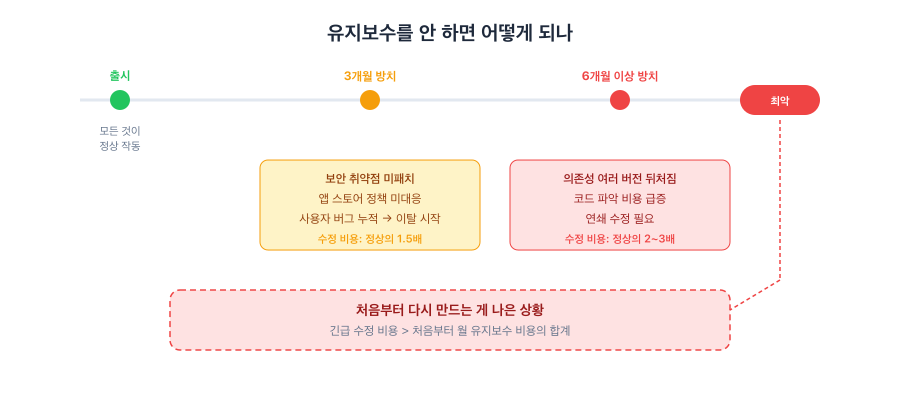
"We'll just launch and fix things when they break" is the most expensive strategy.
After 3 months of neglect:
- Unpatched security vulnerabilities increase breach risk
- App store policy changes go unaddressed — your app could be pulled
- User-reported bugs pile up and users start leaving
After 6+ months of neglect:
- Dependency versions fall several major versions behind, causing cascading changes when updating
- Code context is lost, making fixes 2–3x more expensive
- Worst case: rebuilding from scratch is cheaper than fixing
Emergency fixes after 6 months of neglect almost always cost more than continuous monthly maintenance would have.
4 Ways to Reduce Maintenance Costs
1. Start Maintenance Before the Warranty Expires
Transitioning without a gap is the most efficient approach. The longer you wait, the more it costs to re-learn the codebase, and the more issues accumulate.
2. Keep the Same Team That Built It
The people who wrote the code know it best and fix it fastest. Handing off to a different team adds code familiarization overhead. Third-party maintenance typically costs 1.5–2x compared to the original team. No documentation and no tests? Even more.
3. Demand Clean Code During the MVP Phase
Technical debt drives maintenance costs up exponentially. Spending slightly more time upfront for a well-structured codebase is far cheaper long-term. When comparing vendors, pick "the cleanest builder" over "the cheapest quote."
4. Ship Fewer Features
More features means more to maintain. Minimizing features at the MVP stage naturally reduces maintenance costs. This is the most reliable way to cut not just development costs, but maintenance costs too.
Maintenance Contract Checklist
When signing a maintenance contract, verify these items.
Scope
- Is the included scope specifically defined (bug fixes, security patches, minor changes)?
- Are exclusions listed (new features, design changes, major refactoring)?
- Is there a clear standard for distinguishing "bugs" from "feature requests"?
Cost Structure
- Is there a monthly work-hour credit?
- Are rollover rules stated for unused hours?
- Are overage rates and approval procedures defined?
Service Level
- Is a response time SLA specified?
- Is a monthly report provided (work log, remaining hours, error summary)?
- Are warranty and maintenance clearly separated?
The most common point of conflict is "is this a bug or a feature request?" The answer must be based on the original specification. If the spec says it should work a certain way and it doesn't, it's a bug. If the spec never mentioned it, it's a new feature. Without this standard in the contract, you'll fight about it every time.
Wrapping Up
An MVP isn't done when it launches — it starts when it launches. If you don't plan for post-launch costs from the beginning, you'll either abandon the service in a few months or spend nearly as much as a rebuild. Budget 15–25% of your development cost annually for maintenance. That's the most sensible investment.
If you're unsure how to plan for maintenance, share your project details. We'll help you structure the right maintenance plan for your architecture.
Get notified of new posts
We'll email you when a new blog post is published.