
Built an MVP in a Day? The Real Work Starts on Day Two
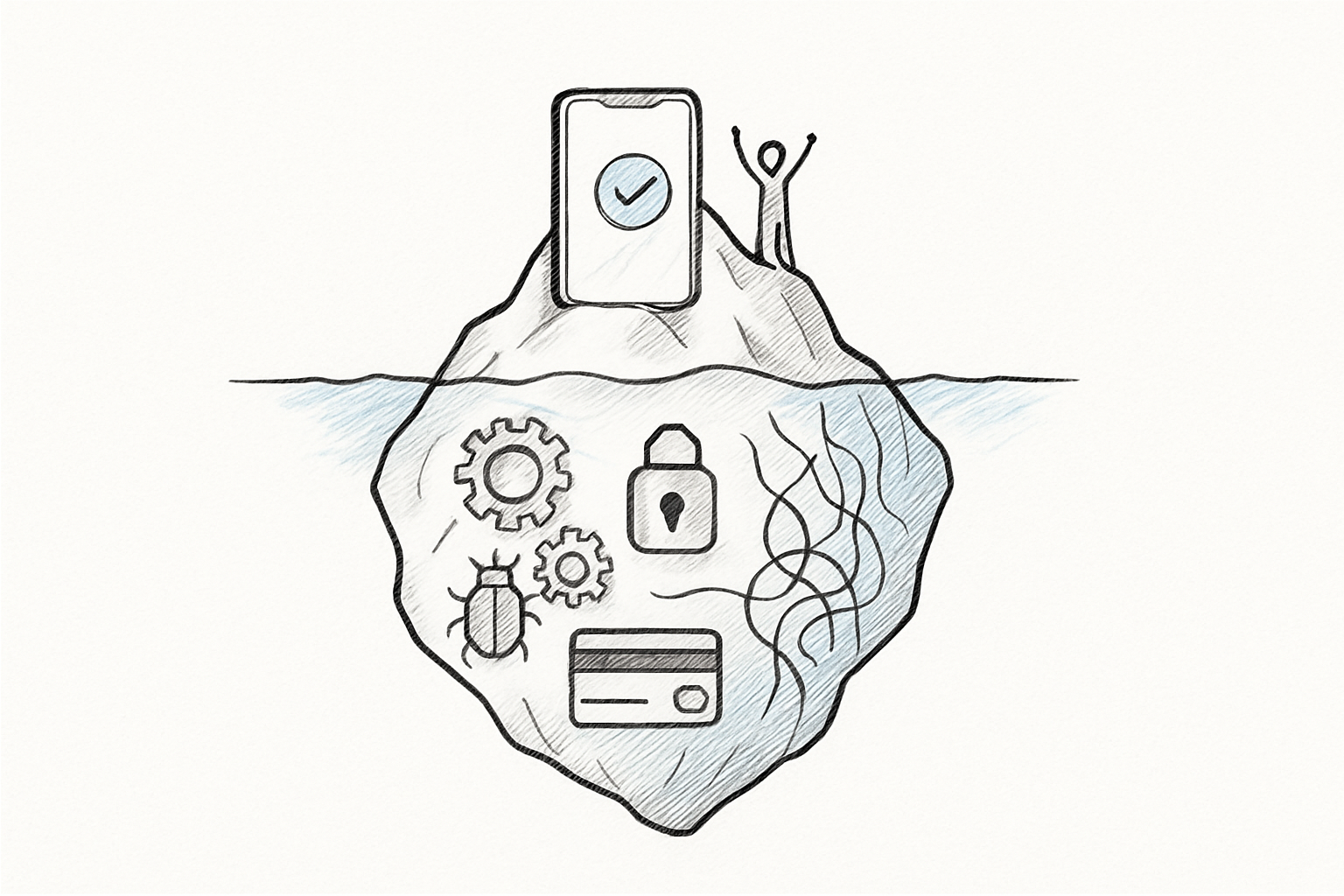
The idea that you can build an MVP in a day with AI is spreading. You can. But that's a demo, not a product. Building is 10% of the work — the other 90% starts the day after launch.
The short version
"I built an MVP in a day with AI" is something I hear a lot lately. You can. I can too — maybe faster. But let's be clear: that's a demo, not a product.
Eighteen years and dozens of launches boil down to one line: building is 10% of the work. The other 90% starts the day after launch.
A week later, everyone was right where they started
I once ran an AI coding workshop myself. People who'd never written a line of code each "built" something in three hours. Screens moved, buttons clicked. In the room, it was genuinely moving.
A week later, curious, I asked: "So how far did you get?"
Most were right where they'd started.
It wasn't strange. Not because they were lazy — but because what they'd built in a day was the end of a demo, not the start of a product. Having finished the easy 10%, they stalled, not realizing the real work begins exactly there.
What starts on day two
A demo only has to show the cases that work. A product has to handle every case that doesn't.
- Real data is always messy. Real users put emojis in their names, submit blank fields, and tap the same button twice.
- Payments are more about failure than success. Wiring it up takes half a day; refunds, partial cancellations, and double-charges are the real volume.
- Security, concurrency, and scale are invisible with one user and break with ten.
- Maintenance — policies change, vulnerabilities surface, edge cases pile up. It doesn't end at launch; it begins at launch.
This 90% never shows on screen. That's why "in a day" fools everyone.
What AI's 10x can't shrink
Don't get me wrong — I use AI heavily. It makes what I used to hand-code feel close to 10x faster (we measure the time against a WBS). But what gets faster is only the time spent typing code. Three things don't shrink:
- Deciding what to build (spec) — AI is great at "how," but it can't decide the "what" and "why" for you.
- Checking that it's right (review) — if you don't understand why the code works, you're just piling up wrong answers faster.
- Confirming the hypothesis holds (validation) — this is the whole reason an MVP exists.
Even if building is 10x faster, if these three stay the same, the whole thing isn't 10x faster — it's maybe 1.5x. That's why "a day" is unrealistic.
An MVP isn't built — it's validated
The M in MVP is Minimum, but the heart is the V — Viable, "able to be validated." The point isn't code; it's hypothesis validation — the fastest way to answer "do people actually want this?"
So the goal isn't to build fast. It's to learn fast. Fast building without validation is just being wrong faster.
Wrapping up
Building something in a day is impressive, and the lower barrier is a real gift. Just treat that "day" as a start, not a finish.
What we actually do is closer to designing everything after day two than to building itself — deciding what to validate, handling the cases that don't work, making it survive past launch.
If you've got something you want to build but can't gauge "where the real work begins," start by mapping the scope with our free MVP diagnosis.
Get notified of new posts
We'll email you when a new blog post is published.