How to Prepare a Prototype (MVP) for a Startup Competition
When a startup competition requires a working prototype, here's how non-technical founders can realistically plan scope, budget, and timeline for their MVP.
Bottom Line
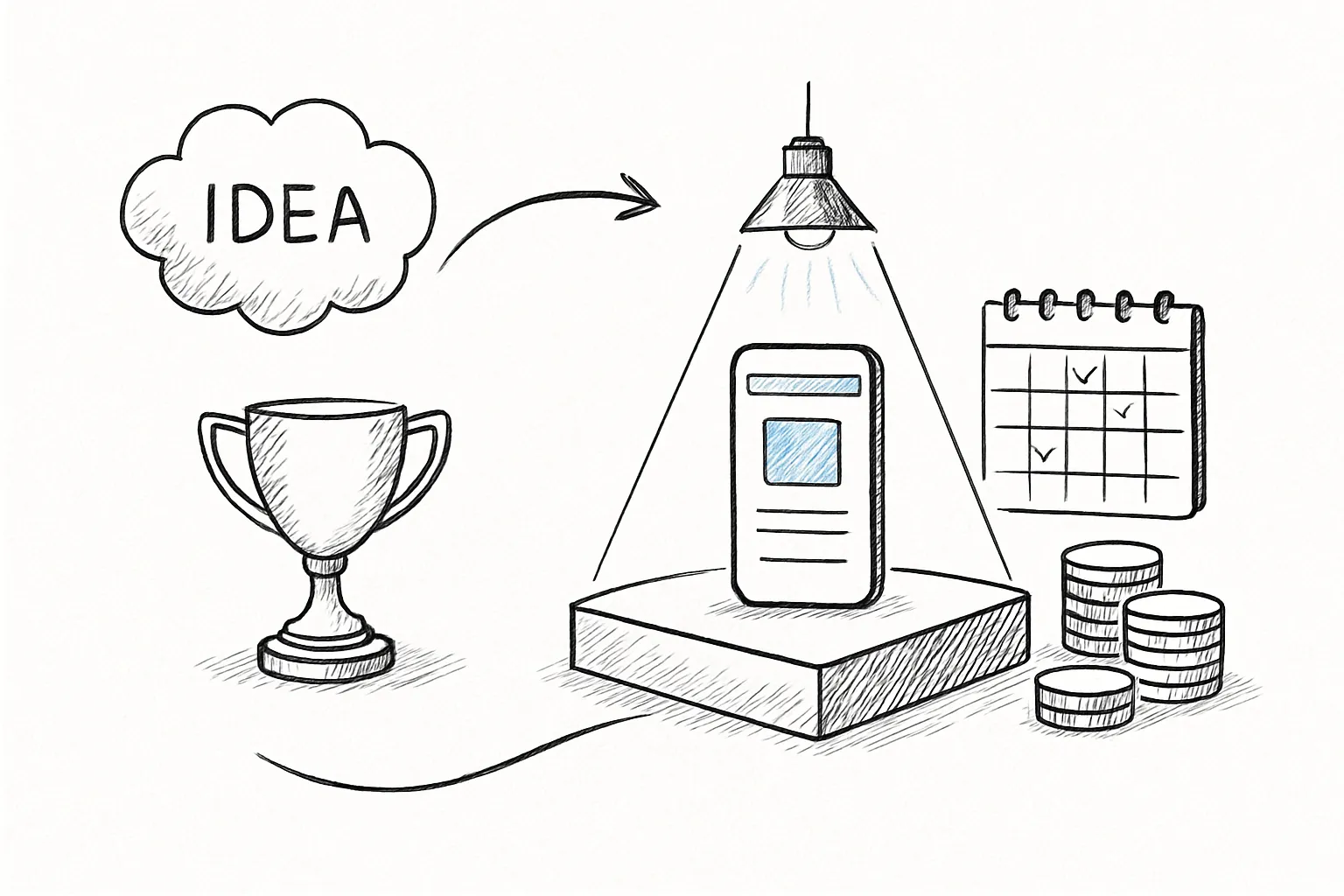
A prototype is not a finished product. In a startup competition, its purpose is to prove "this idea actually works." Build the bare minimum with 1–2 core features. Everything else can wait until the next round.
Why Prototypes Matter in Startup Competitions
Startup competitions around the world — from Y Combinator's Startup School to government-backed programs — increasingly require working prototypes, not just pitch decks.
In Korea, the 2026 "Modoo Startup Project" run by the Ministry of SMEs selects 5,000 participants. Pass the idea screening, and you receive seed funding plus AI solution credits. But here's the key: from Round 1 onward, up to $7,500 in prototype funding is provided. That means you need a prototype plan to advance, and you'll need to actually build one if you pass.
Most pre-startup founders have no development experience. They know they need a prototype but have no idea where to start, what to build first, or how much it should cost. That's where things go wrong.
The 3 Most Common Prototype Mistakes
1. Designing a Full Product
"User registration, payments, admin panel, push notifications, analytics dashboard..."
Many founders list 20+ features in their first planning session. That's not a prototype — that's a full product spec.
A prototype's job is to answer one question: "Do users respond to this idea?" Does answering that require user registration? An admin dashboard? Usually not.
Keep only the 1–2 features that prove your core value. Add the rest after validation.
2. No Framework for Judging Costs
Get quotes for the same idea, and Agency A says $15,000 while Agency B says $4,000. Ask why, and the only answer is "time × headcount."
The problem is that non-technical founders can't see the difference. There's no framework to distinguish a $4,000 validation MVP from a $15,000 over-engineered product.
How complex is each feature? What tech does it require? What skill level of developer? Without understanding these, you can't judge whether a quote is fair. You end up either trusting the number blindly or picking the cheapest option. Both are risky.
3. Ignoring the Competition Timeline
Competitions have deadlines between rounds. You need to deliver a working prototype within a fixed window.
But development almost always takes longer than expected. A plan to build 10 features in 3 months usually ends with 5 barely finished and the rest abandoned.
Set a realistic scope that fits the competition timeline from the start. A 70%-complete prototype with a working core beats a perfect plan with nothing to show.
A Realistic 4-Step Prototype Plan
Step 1: Pick One Core Feature
"What's the first action a user must take in this service?"
Answer that, and you have your core feature. For a delivery service, it's "placing an order." For a matching platform, it's "requesting a match." For an education platform, it's "watching a lesson."
That one feature working smoothly is your prototype. Everything else comes after validation.
Step 2: Define Scope Within Your Budget
Realistically, your initial prototype should target the $1,500–$4,000 range with core features only. Figure out what's buildable within that budget first, then expand with competition prize money in the next round.
| Budget | Feasible Scope |
|---|---|
| Under $1,500 | Landing page + core feature prototype |
| $1,500–$4,000 | Mini MVP with 1–2 working core features |
| $4,000–$7,500 | Core features + 2–3 supporting features, user-testable |
Step 3: Break Features Into Modules
"Payment feature" looks like one item on paper, but in reality it breaks down like this:
| Module | Complexity | Required for prototype? |
|---|---|---|
| Product selection screen | Low | Yes |
| Shopping cart | Medium | No (single-item checkout works) |
| Payment gateway integration | High | Maybe (test payments can substitute) |
| Receipt/confirmation | Medium | No (next phase) |
| Order status management | Medium | No (next phase) |
Breaking features into modules reveals what's essential now versus what can wait. Skip this step, and "should be about this much" turns into a blown budget and missed deadline.
Step 4: Work Backwards From the Deadline
Count backwards from the next round deadline.
- Development time: actual weeks available for building
- Review/revision period: reserve 20–30% of total time
- Buffer: 1–2 weeks for unexpected issues
If you have 8 weeks, realistic development time is 5–6 weeks. Only include features you can finish in that window. Cutting scope is the most reliable way to improve quality.
Wrapping Up
In a startup competition, the prototype isn't about completeness — it's about proving "this idea works in practice."
Build small, demo fast, collect feedback, and improve in the next round. That's the most realistic strategy.
If you're unsure about your prototype's scope and budget, share your idea and available funding. We'll help you figure out which features to build first and what's feasible within your budget.
Related: You Didn't Win the Startup Contest — Here's Why You Should Still Build Your MVP
Related: Passed the Idea Round of Korea's Largest Startup Competition
Get notified of new posts
We'll email you when a new blog post is published.