
Three Reasons AI Adoption Stalls Halfway
Many companies bring in AI and find a few months later that nobody uses it. The data is scattered, staff don't use it, and there is no developer to fix it. Here is why all three have to be solved together.
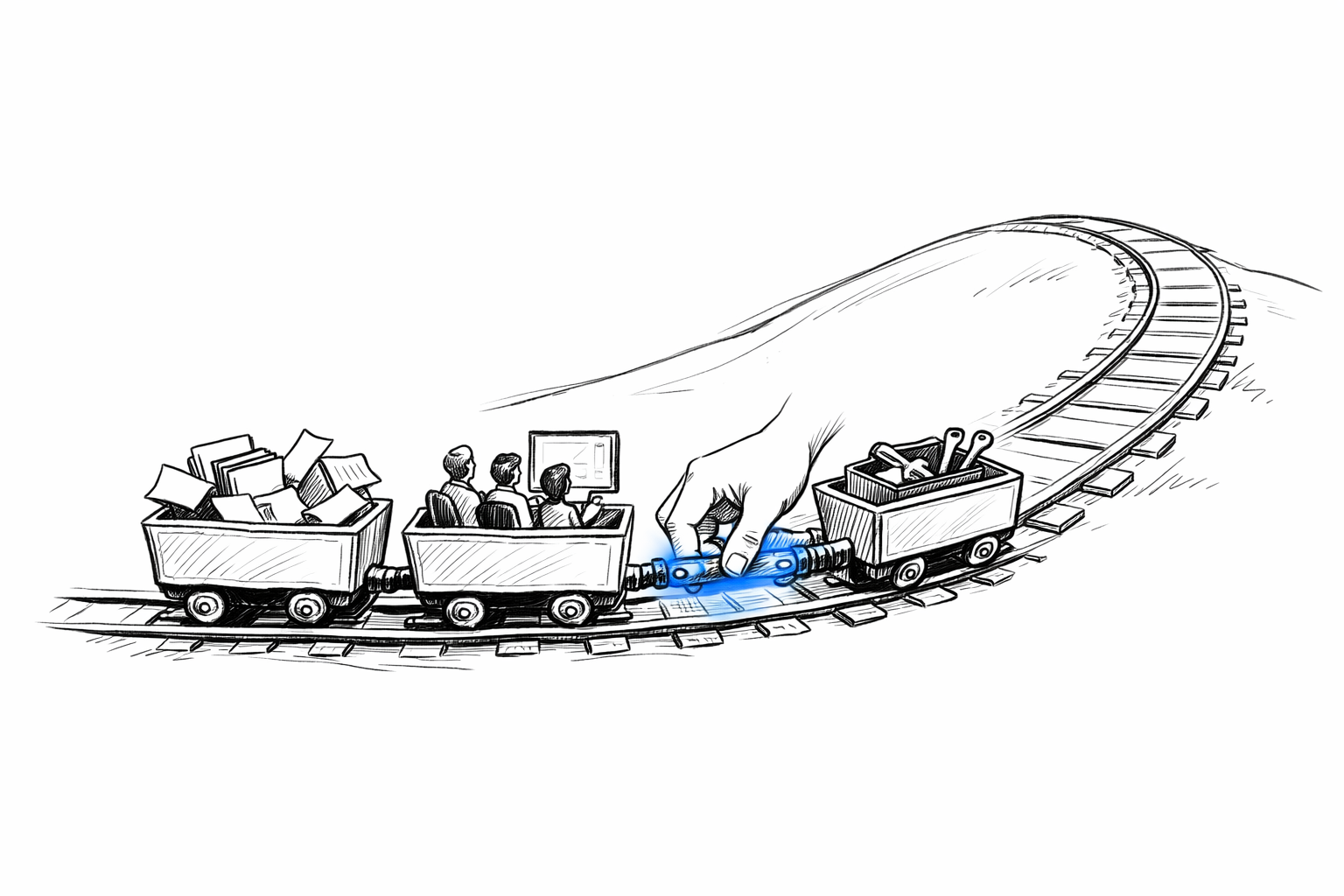
AI adoption usually stalls for three reasons. The data is spread across outside tools so AI can't use it, staff don't use the new system or the AI, and there is no developer to fix things after rollout. If even one of the three remains, adoption stops within a few months.
Why does AI adoption stall halfway?
When we look at companies where adoption stalled, a missing tool is rarely the problem. The tool arrived, but the data it needs, the people who should use it, and the people who could fix it were not in place.
AX means changing how a company works so that AI fits into it. That is a different scope from bringing in one tool. Solve the three reasons one at a time and you get stuck again on the other two.
Why can't AI work with scattered data?
AI only works with what it can see. When chat, approvals, documents, and customer records sit in different outside tools, AI can't make good use of any of them.
So MVPIT starts by looking at the internal tools a company uses today, how people work, and where the data lives. Existing services stay on and are connected through APIs, and the data does not leave the company's servers.
Among the cases published on our /ax page as of October 2026, a foreign resident services company was running an old system, keeping documents in separate storage, and having staff type document contents in by hand. We moved the data to a new system with nothing lost along the way, and changed identity documents to be read automatically.
What if staff don't use the AI?
If staff don't use the new system, the rollout isn't finished. That is why training is built into the rollout itself rather than sold separately. Old tools and the new system run side by side for a while, and employees, support agents, and the dev team are each trained for the work they actually do.
In another /ax case, at a budget mobile carrier, AI-written answers don't go to customers directly. Support agents review and edit them before sending, and the edited answers become reference for the AI from the next day. The more agents use it, the better it gets, so they have a reason to keep using it.
What if there's no developer to fix things after rollout?
Any system in daily use will need fixes. Without someone to make them, people put up with the inconvenience and eventually drift back to the old way.
MVPIT opens QAbox as the request channel. People post what needs fixing or what they want, and AI reviews it and makes the fix. The person who asked checks the result, and if it isn't solved, sends it back with a reason. Fixes don't pile up even without developers in house.
Why solve all three in one place?
Connecting the data, getting staff to use it, and fixing it afterward depend on each other. Connected data makes the system worth using, use reveals what needs fixing, and fixes bring people back to using it.
As described on /ax, MVPIT handles installation, staff training, and later fixes together. Solving the three within one flow is what keeps AI adoption from stalling halfway.
You can see how we stay with you from installation to adoption on the AX Solutions page.
Get notified of new posts
We'll email you when a new blog post is published.